
Meteorite thermal history accessed in 3D by non-destructive multimodal X-ray imaging
Chondrites are a class of meteorites that represent some of the oldest solid materials in the solar system. Within chondrites, olivine grains exist in both the rock’s matrix and within spherical, silicate-rich particles, called chondrules. These chondrules represent molten droplets that crystallized rapidly during dust collisions in the solar nebula. The thermal conditions and timescales at which this occurred are partly reflected in the chemical gradients, or compositional zoning, within olivine grains. Interpreting this information from olivine zoning profiles has traditionally utilized data collected from 2D petrography and chemical analysis on polished thin sections. However, this method is both destructive and time-consuming. Furthermore, elemental diffusion in olivine is anisotropic, and 2D sectioning does not guarantee a cut through the center of a grain or provide access to zoning profiles that are typically orthogonal to crystallographic axes, important factors when it comes to modeling diffusion timescales.
Meteorite sample and characterization techniques
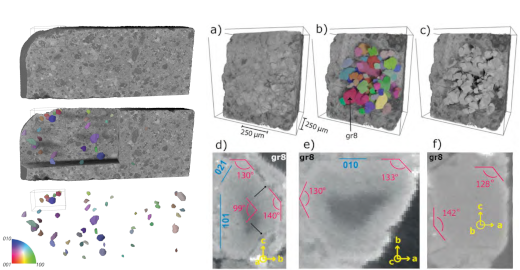
A group of researchers, led by Matt Pankhurst from Gaiaxiom ApS and Rhian Jones from The University of Manchester, set out to demonstrate that the use of multimodal lab-based X-ray imaging techniques can provide valuable new 3D insights to chondrule formation. The sample investigated was a 0.8 x 2.5 x 5 mm piece of the Northwest Africa (NWA) 11346 carbonaceous chondrite.
First, they showed that the density information obtained through absorption CT on a Zeiss Xradia Versa 520 compares well to calculations using monochromatic synchrotron data. Also, they confirmed the relationship between density and the Mg/Fe ratio in olivine with energy dispersive spectroscopy. They then used the LabDCT Pro module to measure the crystallographic orientations, shapes and locations of 77 olivine grains larger than 50 μm within a chondrule. Finally, by using the DCT results, they rotated the XYZ axes of the 3D tomography to align with the orthorhombic axes of individual olivine grains and made virtual profile cuts through grain centers to access zoning profiles. The next step will be to interpret the 3D zoning profiles in the context of crystal growth and diffusion models to infer the thermal conditions and timescales of chondrule formation.
3D non-destructive access to a statistically significant number of thermal probes
The video shows how a combination of X-ray imaging modalities has been used to measure crystallographically oriented 3D zoning profiles of 77 individual olivine grains in a chondrule of the NWA 11346 meteorite. To our knowledge, this is the first time that a 3D dataset for modeling the diffusion timescale of a meteorite’s thermal history has been acquired. Multimodal X-ray imaging has left the sample intact for further analysis, placing the method as a natural first step in future 3D petrographic workflows, especially for precious samples like those from space return missions.
American Mineralogist
See also
GrainMapper3D Application Note – Meterorite thermal history accessed by multimodal imaging
