
Twin formation during abnormal grain growth in pure Ni
Twin boundaries in FCC metals can strongly influence key material properties, including corrosion behavior and fatigue resistance. A better understanding of how and why twins form during abnormal grain growth (AGG), where a small fraction of grains become much larger than the surrounding matrix, allows for advanced grain boundary engineering to design alloys with superior durability.
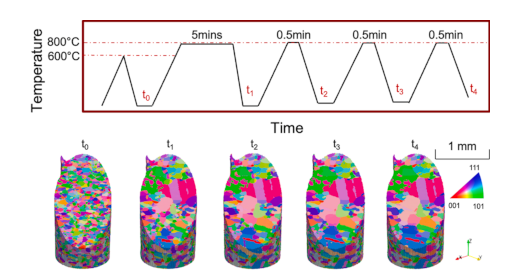
A group of researchers, led by Amanda Krause from Carnegie Mellon University, utilized LabDCT to measure the three-dimensional grain structure evolution in high-purity nickel during both an AGG event and through three subsequent annealing steps at 800°C. By non-destructively tracking the bulk microstructural changes, the research team captured the exact structural conditions under which the twins originate and migrate.
Competing twinning mechanisms
The experimental results showed that most of the observed twins were already present after the initial AGG step. Furthermore, the analysis revealed that new twin boundaries formed during the subsequent annealing were dominated by twin nucleation rather than grain growth encounter.
The data confirmed that while each new twinned grain increases the total grain boundary surface area, the formation ultimately reduces the overall grain boundary energy of the local network. This demonstrates that twin formation during grain growth is governed by multiple concurrent mechanisms and highlights the role of grain boundary velocity and grain boundary energy distribution on twin formation.
Materialia
Twin formation during abnormal grain growth in pure Ni
See also
4D Observations of the initiation of abnormal grain growth in commercially pure Ni
