
3D mapping of polar ice cores using multimodal laboratory X-ray microscopy
Ice cores of Earth’s polar ice sheets provide important records of past climate and large-scale ice flow. Deciphering those records requires an understanding of the ice microstructure over the depth of the ice sheet. Since drilling began in the 1950s, scientists have accessed and analyzed thousands of meters of polar ice cores. Using cm-scale 2D thin sections of the ice cores, crystal orientation and size measurements are routinely performed with automatic fabric analyzers or other methods relying on optical microscopy.
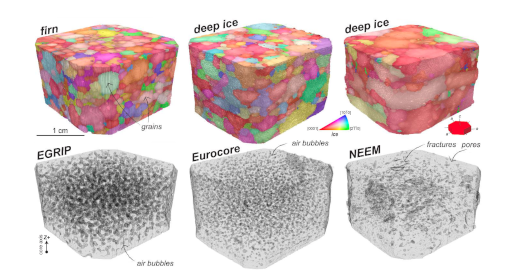
Through a collaboration with Lund University and glaciologists at the Niels Bohr Institute, University of Copenhagen, our team has developed a multimodal X-ray microscopy method for imaging and analyzing ice core samples in 3D. A combination of absorption and diffraction contrast tomography allows ice grains and air bubbles containing ancient atmospheres to be correlated and analyzed based on their 3D shapes, volumes, and orientations, complementing the traditional 2D analyses of ice cores. Our measurement approach is facilitated by a specially designed cooling device that accommodates ~3 x 3 x 3 cm3 samples containing hundreds to thousands of grains.
First results on ice cores from Greenland
The method was tested on one firn (shallow ice) and two Holocene-age deep ice samples, all from drilling sites in Greenland. Our 3D data showed variations we would expect in grain size and orientation as well as porosity and deformation, based on previous observations made from a combiation of 2D techniques. The added information of grain and air-bubble shapes and sizes in 3D complements tradtitional 2D data that, together, can help improve micro-scale models of ice deformation and paleoclimate reconstructions.
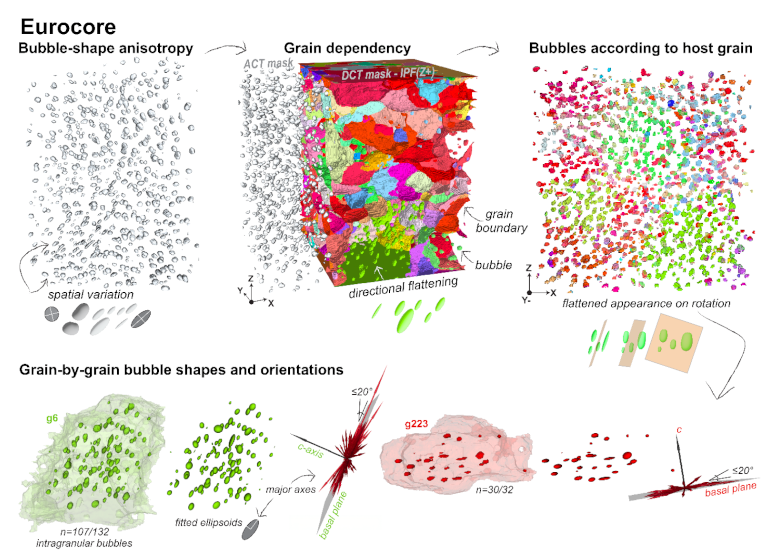
The collection of correlative multimodal data enabled us to analyze spatial relationships between ice grains and air bubbles in 3D. We found grain-dependent bubble shape anisotropies and a notably strong correlation between the directions of bubble flattening/elongation and the c-axis/basal plane of the hexagonal host grain. Because air bubbles deform faster than the surrounding ice grains, the shape correlations we found may be used to reconstruct the ice deformation history at the grain-scale. Additionally, the spatio-temporal relationships between ice grains and air bubbles could help inform interpretations of the ancient atmospheres contained within the bubbles, ultimately improving reconstructions of past climates.
Journal of Glaciology
Mapping textures of polar ice cores using 3D laboratory X-ray microscopy
See also
Meteorite thermal history accessed in 3D by non-destructive multimodal X-ray imaging
